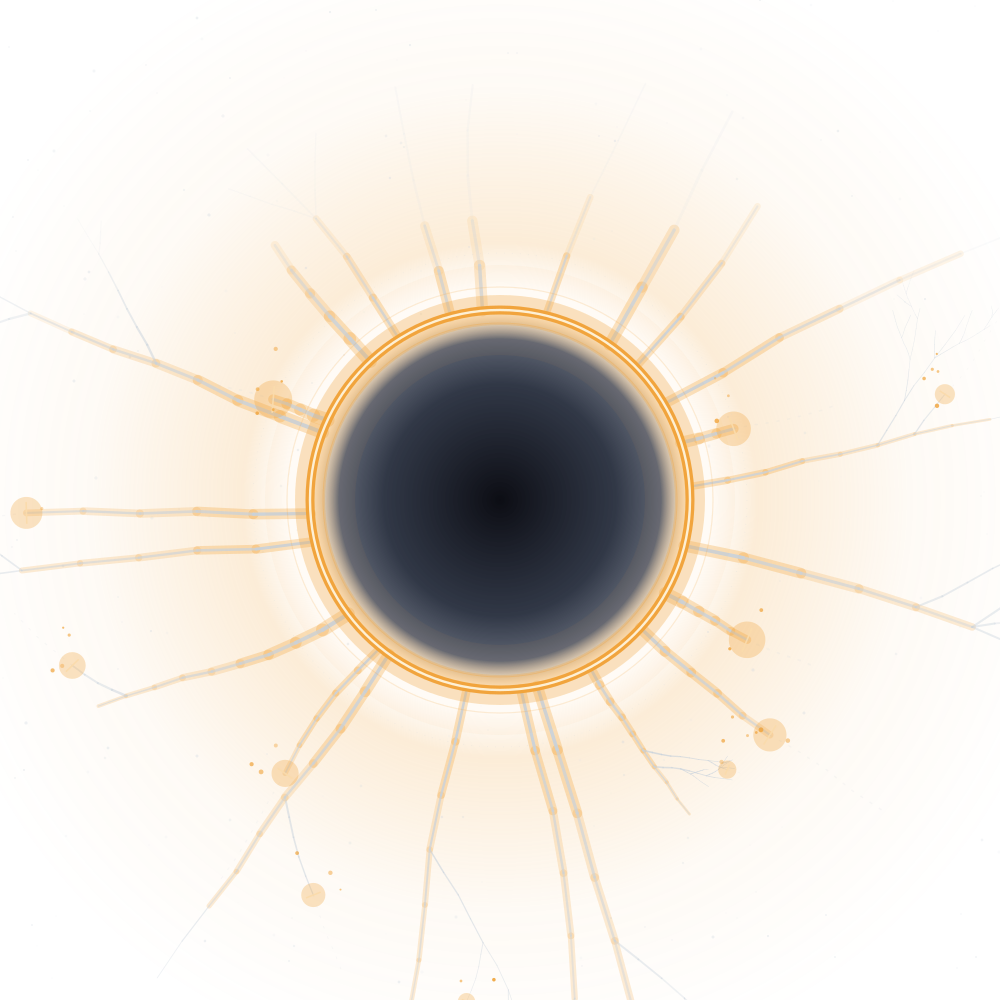
The radio on my knee says “Medic” the way the Survey says everything, like it’s reading it off a docket.
“Medic, hut. Somebody’s down on the path below me. Medic, do you read?”
I read. I’ve been sat on the fence line since half ten on a jacket folded in four, with the gate post at my right shoulder and the Quiet Ground running away uphill in front of me: a slope of grey scree the size of a school field, pegged out in squares with white tape, and snow still packed into the hollows. It’s the eighth of July. There’s snow. Nobody up here thinks that’s worth a remark, so I’ve stopped remarking.
“Medic here. What’ve they done?”
“Fell. I heard it go.” The carrier hisses. “She’s talking.”
Talking is good. Talking is an airway.
I get up off the left leg and bring the right one after it, the way you’d bring a dog that won’t come, and pick up the jacket and the kit bag. The hut is forty metres along the fence, a tin box on legs with one lit window and a stovepipe. Below it the path drops off the summit road and runs down the outside of the wire towards the snowfield, and it’s bad, that path, all flat plates of shale that slide over one another like crockery in a dropped box. I’ve told Calloway. Calloway has written it down.
Nineteen nights. By the copy of the log on the mess board the next one is due any night this week or next, and I’ve read it enough times to have it by heart, which is more than I can say for anything else in this country. I look at the Ground once more as I go, because I always do. Scree. Tape. The centre marker, a steel post with a reflector on top, which catches my torch and throws it back. Somebody has tied a child’s red mitten to the wire at the eleventh post. It was there when I came up in June. Nobody’s said whose.
She’s twenty metres below the hut, on her side against the fence, with a battery beside her in a canvas sling. A square black lead-acid one, the sort the hut runs its instruments off. It’s still upright. That’s more than can be said for her.
“Don’t get up,” I say. “I’m Nora, I’m the medic. What’s your name?”
“Anika. Rudd. I’m fine. I think I’ve done my wrist.”
“Stay still for me while I look at you, Anika.”
Primary survey. Scene: loose shale, a slope, the fence at her back holding her on it, nothing coming down on us from above. Catastrophic bleeding: no, but the hair on the left side of her head is black and wet in the torchlight and running into her collar, and scalps bleed like they’re on piece rates. Airway: she’s telling me she’s fine, so it’s open. She’s telling me in full sentences, so it’s working. Breathing: quick and high up in the chest, which is the height and the fright. Circulation: radial pulse on the left, fast and strong. I don’t go for the right one yet. The right wrist is lying across her stomach in the shape of a fork put down on a table, the back of the wrist stepped up off the line of the arm, and she’s holding it against her like it’s something she’s been asked to mind for somebody.
“Did you bang your head?”
“I don’t. Yes. On the post, I think. To be fair, I didn’t see the post.”
“Did you black out?”
“No.”
“Does your neck hurt? Here? Here?” I walk two fingers down the back of her neck, one bump at a time. Nothing. Her eyes follow the torch and come back to my face. She knows it’s Thursday. She knows she’s on Kestrel Peak and that she was bringing Mr Ashdown a battery because his charger’s packed in and the dome’s got two, and she’d rather carry one down in the dark than have him ring the dome at that hour. She tells me the name of the Chief Astronomer, which I don’t know, so I take her word for it. Fifteen out of fifteen. I’d have docked her one for the battery.
“You’ll live,” I say. “You’ve broken your wrist.”
“Oh.” She looks at it properly for the first time. “Oh, that’s horrible.”
“It is a bit.”
I kneel on the folded jacket. Shale moves under it and my right knee tells me what it thinks, which is the same thing it tells me every time, and I let it. The kit bag is the one I brought up in June and repacked in my first week, because the one the Survey left in the infirmary had a splint in it from before the Turn, still in its wrapper, and a bottle of iodine that had gone the colour of tea. I’ve got a padded aluminium splint, crepe, tape, dressings, a foil blanket and the torch.
“I’m going to splint it how it is,” I say. “I’m not going to straighten it. That’s for somebody with an X-ray. It’ll hurt when I lift it and then it’ll hurt less. Wiggle your fingers for me.”
She wiggles them. They’re cold, and slow, but they move. I pinch a nail and count how long the pink takes to come back. Under two. Which finger am I touching? That one. That one. That one. Good.
“Where are you from?” I say, because you give people something to hold that isn’t the pain.
“Spokane Falls. The dry side.” Her breath catches as I slide the splint under. “You’re not from here.”
“No.”
“Where are you from?”
“Leeds.”
“I don’t know where that is.”
“Nobody does,” I say, and it’s the truest thing I’ve said since March.
I fold the splint into a long U, up under the forearm and round the elbow and back along the top, a sugar-tong, the way they showed us on a wet afternoon in a portakabin in Wakefield with a trainer who kept saying if in doubt, pad it out. I pad it out. Far off, down past the snowfield where the valley opens, an airship is going over. You don’t hear it so much as feel it in your back teeth, a slow drone with a slap in it, and its lights go along the underside of the cloud like a train seen from a bridge. The mail ship to the coast, probably. They run all night here. The first week I saw them I stood and watched one for a quarter of an hour.
I start the crepe at the knuckles. One turn. The wind is coming up the slope from the snowfield and it has a note in the fence wire, a thin hum that changes with the gusts. I’ve listened to it for nineteen nights. I could hum it for you.
Two turns. Anika says something about the dome and the schedule. Three.
The note goes out of the wire.
Not down. Out. The wind is still coming, it lifts the loose end of the crepe and lays it back against her sleeve, but there’s no sound on it, and there’s no sound on anything. Anika’s mouth is moving. It makes sorry and something after it. There’s nothing coming out. I tear the crepe with my teeth and it makes no noise at all, and my own breath doesn’t make any noise either, and there’s a pressure in my ears that I have to swallow against.
One.
I know where I am. I’ve always known where I am in this, that’s the thing about it. The silence is a few metres wide and I’m inside it, so whatever’s at the middle of it is close. On the other side of the wire, up on the Ground, ten metres, fifteen at the most.
Two.
The splint is held on by my left thumb and three turns of crepe. If I let go the whole thing slides and the ends of the bone go past each other, and she’s thirty-three or so and an astronomer and she’ll want that hand. Three. The fence is chest height, stock wire, and I’ve climbed it in the dark to see if I could. Four. I could. The knee could. I’ve done the sums on the knee.
Five.
Anika’s face has changed. She’s heard it now, or not heard it. She’s looking at her own mouth moving, cross-eyed, and then at me, and I keep my face the way I keep it at a road traffic collision, which is the face for somebody telling you the price of fish.
Six. Seven.
I put the fourth turn on. I can’t hear it.
Eight. I’ve let them go before. Not like this. I’ve missed them for being in the wrong place, and once for being asleep, and once for a man in a cellar who said he’d be all right on his own and wasn’t. I’ve never let one go on purpose. Nine. There’s a list in my left boot and it’s soft at the folds and I’m not thinking about it.
Ten.
Eleven.
At the edge of my eye, up on the Ground, a line stands up.
That’s the only way to say it. A line of a different dark, a slit in the night that’s darker than the night and straighter than anything that grows or falls, standing on the scree the height of a door. It’s there for one second. I don’t turn my head. I’ve got a wrist.
Then it’s gone, and the wind comes back into the wire in the middle of its note, as if somebody’s taken their thumb off it.
“Can’t hear anything, I can’t hear, Nora, I can’t.”
“You can now,” I say. “You can hear me now. Look at me. It’s done.”
“What was that?” She’s gripping my sleeve. “What was that?”
“Dead air,” I say, because that’s what they call it here, and it’s the only answer anybody on this mountain has ever been given. “It’s over. Keep still. I’ve nearly got this on.”
I finish the crepe. Five turns, six, up to the elbow and back, and tape it, and check her fingers again: warm enough, pink back in under two, she can feel me touching every one. I make a sling out of the triangular bandage and a broad fold round her body to hold the arm still against it, and put the foil blanket round her shoulders, and it crackles, and I rub the edge of it between my finger and thumb to hear it again.
The hut door bangs up the slope. A torch comes down the path at a trot, too fast for the shale, and slithers the last bit, and stops.
Jory Ashdown is twenty-nine and has grease in the creases of his knuckles that he’s never going to get out. He’s got a torch, and a stopwatch on a bootlace round his wrist.
“Everybody all right?”
“Broken wrist,” I say. “Scalp wound. She’s talking. She’s walking in a minute.”
He shines the torch on Anika and off her again, polite. Then on the Ground. Then on me. I’m kneeling on a jacket on the wrong side of the fence from the middle of it, with both hands on somebody else’s arm.
“One fifty-two,” he says. “Eleven point one.”
“Is that long?”
“It’s the same.” He looks at the scree for a while as if he’s expecting it to do something else. It doesn’t. “Were you inside it?”
“I think so. We both were.”
“Hear anything?”
“No,” I say. “That’s the point of it, isn’t it?”
He nods at that as if I’ve told him something he’ll need to check. Then he picks up the battery in its sling, one-handed, and weighs it, and looks at Anika.
“You brought this down.”
“Your charger,” Anika says. “The dome said.”
“You could’ve rung.”
“It was the middle of the night.”
“I’m always up,” he says, and it isn’t a complaint, and she knows it isn’t, and she starts to cry a bit, not about him.
I press a dressing onto her head and get her to hold it there herself, which gives her something to do. The cut’s two and a half centimetres, clean edges, in the hair above her left ear. It’ll want closing. I’ve got glue and I’ve got staples, and I’ll ask her which she’d rather, because nobody ever asks and it changes how they sit for it.
“Can you get her up to the road?” I say to Jory. “Other side of her. Don’t pull on the arm.”
“I’ve a log to write.”
“It’ll keep for five minutes. It’s been keeping for six years.”
He looks at me for that. Then he puts the battery down against the wire, where it can’t go anywhere, and gets his shoulder under her good arm, and between us we stand her up. She’s steady. She’s taller than me by a head. Most people are.
We go up the path a step and a stop and a step. At the hut Jory hands her over with care and goes in, and the window’s light moves as he crosses it to his bench, and the stool scrapes. On the summit road the gravel’s smoother and she can walk on her own if I stay at her elbow. It’s three hundred metres to the station, along the spine, with the dome’s white shoulder in front of us and the kitchen’s security light on over the bins.
I stop at the bend and look up. I always look up. There’s no helping it.
The sky up here is black the way it’s never black in a town, and full, and every star in it is somebody else’s. Six years they’ve had this. I’ve had it since March. I don’t know a single one of them, not by shape and not by name. The Columbians have names for some of them now, the bright patterns, and they print them in the almanac, and the kitchen has one pinned up by the tea urn. I’ve not learned them.
Straight overhead there’s the Window.
It’s small. Four moons across, near enough, a round patch of sky pinned to the top of the mountain, and the stars in it aren’t these stars. They’re the old ones. The ones I grew up under. As the Earth turns they come sliding in at one edge and out at the other, and right now what’s sliding through is a piece of the old Milky Way, the grainy stretch of it that the Survey’s chart labels as the Swan’s back. From our back garden in Kirkstall the Swan was the only one I could find without being shown. I can’t see the whole bird. Just a smear of its back through a hole.
I don’t know these stars. I know the ones in the hole.
Anika’s teeth are going. The foil’s crackling with it.
“Come on,” I say. “It’s not far. There’s a stove.”
She comes. After a few steps she says, very carefully, the way people talk when they’ve had a fright and want to sound as if they haven’t:
“Can I ask you something?”
“Go on.”
“When I came down the path. Before I fell.” She’s watching her feet on the gravel. “You were sitting at the gate. On a coat. In the dark.” Her teeth go again, and she waits for them to stop. “What were you doing at the gate at two in the morning?”
The kitchen light hums. Somewhere back along the spine Jory’s writing it down.
I keep my hand on her back and I walk her to the door.
